
17.08.2026 · news
The connected classroom in Switzerland
Interactive displays, intelligibility, standardization, lifecycle: the decisions that shape classroom equipment in Switzerland
Key takeaways
- Since 2021, digital education has been a subject area in its own right within the Plan d’études romand, which moves classroom equipment from pilot-project status to institution-wide programme.
- The first decision concerns the display: interactive display or interactive projection, depending on the depth of the room and how it is actually used.
- The diagonal is calculated from the distance of the back row and the density of the content shown, not from the floor area of the room.
- Speech intelligibility can be measured. The index depends on both reverberation and the signal-to-noise ratio: turning up the volume does not compensate for a reverberant room.
- A teacher moves between rooms several times a day. Standardizing interfaces from one room to the next weighs more on real-world use than the feature set of any individual device.
- A school estate is sized over ten years: software lifecycle, remote monitoring and maintenance are decided at the point of purchase.
The connected classroom is no longer an experiment. Institutions now equip dozens of rooms at a time, with everything that implies: consistency between spaces, operating budget, staff training and equipment service life. The technical decisions taken at tender stage either cost or pay off over a decade. Here are the trade-offs that shape these projects.
A pedagogical framework that has changed scale
The Swiss context has moved quickly. The CIIP adopted an action plan for digital education, and the Plan d’études romand, the shared curriculum framework applied across several Swiss cantons, incorporated a digital education component in 2021, built around three strands: the use of digital tools, an introduction to computer science, and media literacy.
The material consequence is straightforward. A competence prescribed in the curriculum can no longer rest on a handful of equipped rooms: it calls for a consistent, available and maintained estate across all teaching spaces. Cantons have launched multi-year deployment programmes accordingly, and upper-secondary and tertiary institutions have followed the same movement.
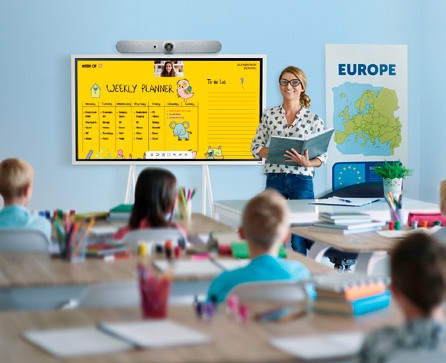
The first decision: which display for which room
Two architectures coexist, and the choice is not made at institution level but room by room.
- The interactive display brings panel, touch layer and software together in a single device. Nothing to calibrate, instant start-up, centralized estate management. It suits standard classrooms and group work spaces.
- Ultra short throw interactive projection frees you from the size of a panel. It remains the answer for deep rooms, lecture theatres and configurations where a large image takes priority.
- LED walls take over in large volumes and brightly lit spaces, where the image has to stay legible in full daylight.
Two points are worth settling as early as possible in the project. First the diagonal: it is calculated from the distance of the back row and the nature of the content projected, an exercise we set out in our article on the right screen size for a meeting room. A page of textbook text or a table of data does not call for the same image as a slide of titles.
Then the vocabulary of the specification. Interactive whiteboard, interactive display and touch screen describe different architectures, with distinct installation costs and maintenance plans: we devoted an article to the differences between an interactive whiteboard and a touch screen. Our interactive panels, LED walls and video projection configurations always start from the geometry of the room.
Intelligibility, the criterion not to overlook
A classroom is a place where people speak all day long. Yet it is the display that captures the attention of specifications, while comprehension of speech directly conditions pupils’ attention and teachers’ vocal fatigue.
The speech transmission index expresses the proportion of spoken information preserved between the person speaking and the person listening, on a single scale, and a simplified measurement method exists for use in the field.
The main lesson is counterintuitive. The index depends on two simultaneous factors: the reverberation of the room and the ratio between the level of the voice and that of the background noise. In other words, turning up the volume of a sound system does not make up for a reverberant room: the useful signal and the parasitic reflections rise together.
Two levers combine in practice:
- Acoustic treatment of the room, which reduces reverberation and benefits every use, including with no equipment at all.
- Distributed sound reinforcement, with several low-power loudspeakers rather than a single source, paired with a microphone worn by the teacher. The measured effect covers comprehension at the back of the room as much as the preservation of a voice used five days a week.
Our sound systems for education are sized on survey, according to volume, acoustics and use.
Standardization is worth more than a rich feature set
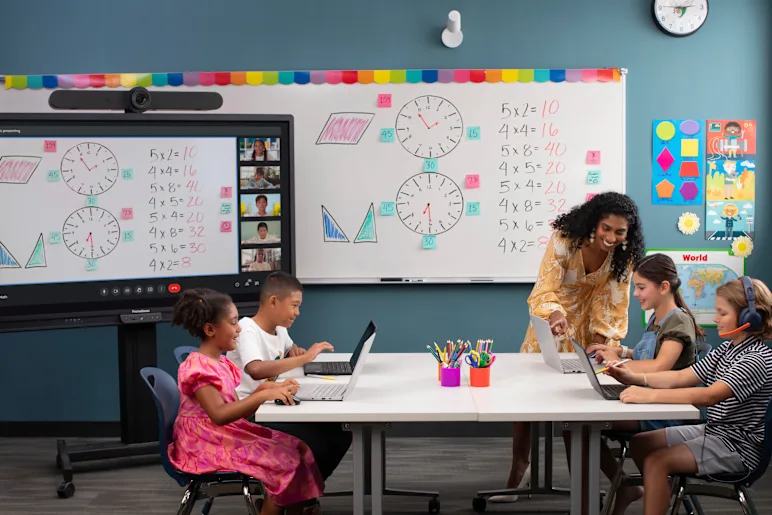
A secondary school teacher commonly uses four to six different rooms in the same week, with a few minutes between classes to get their material up on screen. That reality decides whether a device is adopted, far more than its advanced functions.
- The same interface everywhere. Reducing rooms to two or three typologies equipped identically removes the adjustment time and most support calls.
- One action to start. Power on, source selection, sound and blackout driven from a single interface, with preset scenarios.
- Predictable connection. A single connection method for laptops and tablets, decided upfront rather than inherited room by room.
- Short training. Three typologies can be covered in one session, twenty different configurations cannot.
A school estate is planned over ten years
An institution is not buying a display, it is buying a fleet it will have to operate for a long time. Three points are decided at design stage, not afterwards.
- The software lifecycle. Interactive displays carry an operating system whose version determines how long the device will remain supported and manageable.
- Remote monitoring. Across an estate of several dozen rooms spread over several buildings, reporting equipment status and intervening without travelling changes the economics of support.
- Maintenance. School equipment takes intensive use and constant handling. Our preventive and corrective maintenance contracts are aligned with the school calendar, with work scheduled during quieter periods.
Equipping your rooms
These projects are handled space by space, with a survey of the rooms, the definition of typologies, the sizing of the display and the sound reinforcement, coordination with the other trades, then commissioning, staff training and ongoing follow-up of the estate. Our projects in education include the renewal of more than fifty teaching spaces at the University of Geneva, the Learning Lab and the AULA at UNIL, and the rooms at EHL in Lausanne.
An equipment programme to launch, rooms to modernize, an estate to standardize across several buildings: get in touch to discuss it. We study your spaces, propose a configuration for each room typology and welcome you to our showroom in Plan-les-Ouates by appointment. You can also explore our audiovisual solutions for education and our classroom equipment.
À lire aussi
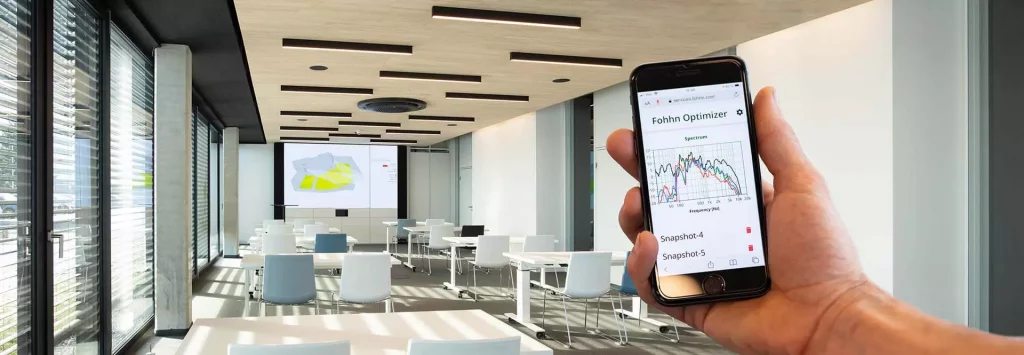
Which audio system brand to choose for your business?
Bose Pro, Fohhn, Yamaha, K-array, Focal, Sonos, L-Acoustics: what sets these audio brands apart and how to choose for your spaces.
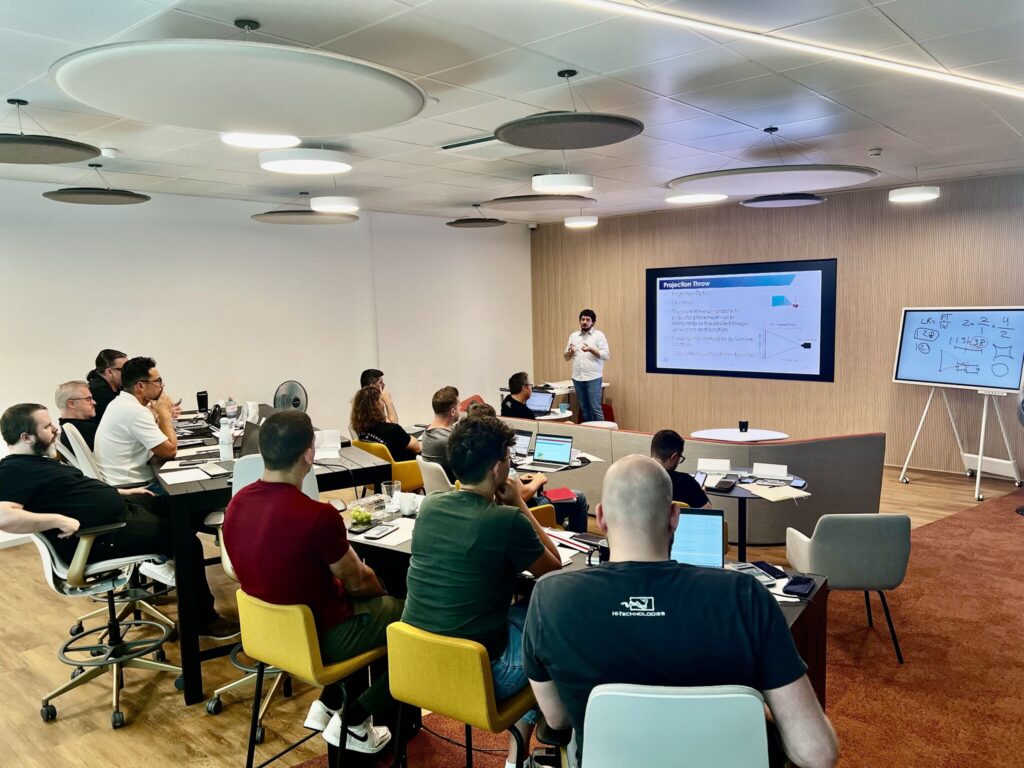
Training room: which screen size should you choose?
Which diagonal for a training room? Distance of the back row, content density and ambient light: the three criteria that matter.
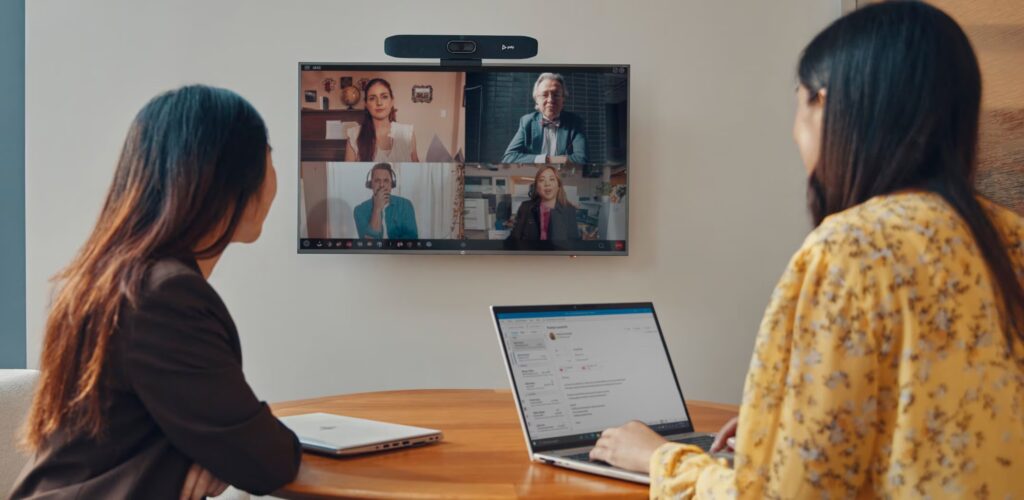
Screen size in inches and cm: full conversion chart
Key takeaways Display size is always quoted as a diagonal, in inches. Here are the full conversion charts and the calculation formulas. …