
22.09.2026 · news
MicroLED vs LED display: what are the differences?
Key takeaways
- Samsung The Wall, LG MAGNIT and Sony Crystal LED are LED displays. The useful comparison is therefore not MicroLED against LED, but MicroLED against the other modular LED walls on the market.
- The difference lies in the diode technology. On a conventional LED wall, each diode is a package soldered onto a board. On MicroLED solutions, the diodes are microscopic and transferred directly onto the module.
- What MicroLED brings: a sharp image even at close range, deep blacks that do not turn grey under lighting, a robust surface and fast installation.
- What a conventional LED wall brings: complete freedom of format, a far wider choice of pixel pitch, and the right answer for large surfaces viewed from a distance.
- Pixel pitch is chosen according to how far away the viewers are, never in absolute terms.
- In most buildings the two approaches coexist: MicroLED in spaces viewed close up, modular in large volumes.
Many projects start with this question: Samsung The Wall or an LED display? There is a misunderstanding in the way it is phrased, because The Wall, just like LG MAGNIT or Sony Crystal LED, is itself an LED display. The real choice lies between two generations of technology, and between two ways of building a video wall. Here is what separates them, what each one brings, and how to decide according to the space you are fitting out.
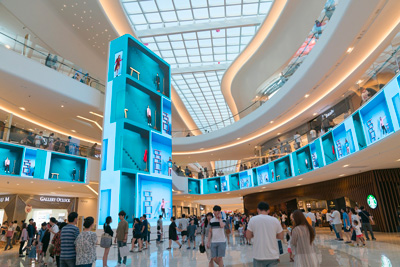
Is MicroLED an LED display?
Yes. Samsung The Wall, LG MAGNIT and Sony Crystal LED all belong to the family of direct view LED displays, with no panel and no backlight, exactly like the LED walls found in entrance halls or supervision rooms.
All these products rest on the same principle: thousands of diodes assembled into modules, themselves assembled into one continuous surface. Each diode produces its own light, which explains the brightness of these displays and the absence of any border between modules. MicroLED is therefore not an alternative to LED walls, it is a generation of LED walls. The real question is what that generation brings, and at what cost in terms of constraints.
MicroLED or conventional LED: what is the technical difference?
It lies in how the diodes are manufactured and mounted.
- Surface mount technology equips the vast majority of LED walls. Each diode is a small package soldered onto a board. The process is mature, economical, and available across a very wide range of pixel pitches.
- MicroLED technology, used on The Wall, LG MAGNIT and Sony Crystal LED, transfers diodes of around a micrometre directly onto the module, with no individual packaging. Far more of them therefore fit onto the same surface.
One point of vocabulary, useful during consultation: MicroLED, COB and surface mount describe manufacturing processes, not brands. Several manufacturers now offer encapsulated diodes that deliver part of these benefits, at varying levels of fineness.
Why choose a MicroLED solution over another LED wall?
Four advantages stand out, above all in spaces where the display is viewed close up.
- A sharp image at close range. Pixel pitches drop below one millimetre. You can look at the display from a few steps away without making out the diodes or the gaps between them, which a conventional wall does not always allow.
- Blacks that stay black. The tiny diodes leave more surface around them, and that surface is treated to absorb ambient light rather than reflect it. This is what prevents the washed-out effect under the lighting of an entrance hall.
- A more resistant surface. With no exposed packages, the display withstands contact better and is easier to clean.
- Fast installation and a predictable result. Pre-assembled versions arrive already aligned and calibrated at the factory, in a fixed format. Installation comes close to that of a very large display: mounting, connection, commissioning, with no on-site alignment phase. This is in particular the argument LG puts forward on its MAGNIT range, with a front alignment system designed to reduce installation time.
These solutions are part of our Samsung, LG and Sony catalogues, alongside professional displays and centralized management solutions.
These solutions are part of our Samsung, LG and Sony catalogues, alongside professional displays and centralized management solutions.
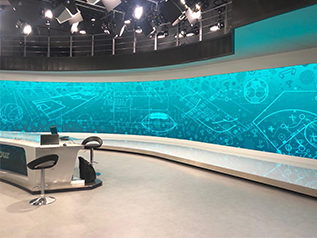
When does a conventional LED wall remain the better choice?
Fixed formats and extreme fineness have their downside. On a good share of projects, a modular wall answers the need better.
- Freedom of format. A wall assembled module by module follows a particular shape: an unusual ratio, an angle, a curve, integration into a recess or around an architectural feature.
- Breadth of choice. The pixel pitches available cover a far wider spectrum, which makes it possible to match fineness precisely to the actual viewing distance.
- Large surfaces. In an auditorium or across an interior facade, viewers are far away and the surface is vast. Extreme density then brings nothing perceptible.
- Tailored maintenance. Front access to the modules and the ability to stock spare parts individually suit equipment intended for continuous service.
This is the territory of manufacturers such as Absen and Aoto, which we integrate regularly on large-scale projects.
Which LED wall for which space?
- Entrance hall and reception area. The display is viewed close up, sometimes from less than two metres, and it contributes to the company’s image. This is where MicroLED is most clearly justified: the fineness and the deep blacks are noticed immediately, including under strong lighting. Samsung The Wall and LG MAGNIT both target this kind of premium use. A conventional wall remains a valid option, but the gap becomes visible as soon as you come closer.
- Boardroom and executive meeting room. The same short distances, with dense content to read on top of that, documents and tables. MicroLED retains all its relevance, whether with The Wall, MAGNIT or the Sony Crystal LED series designed for these environments.
- Supervision room. Operators sit two metres away, the display runs continuously and availability takes precedence over everything else. A very fine pitch is necessary, but this is not always the natural territory of premium solutions such as The Wall: the choice tends to go to walls built for permanent service. That is the logic behind our control rooms and crisis management rooms projects.
- Auditorium and large room. Viewers are far away and the surface is extensive. At that distance, the contribution of MicroLED is no longer visible and the additional density translates into no perceptible gain. A modular build, with a pixel pitch calculated on the back row, answers the need better and covers a larger surface for an equivalent budget.
- Retail and public spaces. Brightness, surface robustness and ease of cleaning come before extreme fineness. MicroLED solutions keep genuine relevance on storefronts and corners viewed close up, where image quality is part of the message.
In most buildings the two approaches coexist: MicroLED at reception, modular in the auditorium. Making several display technologies work together in the same building is a significant part of our work as an audiovisual integrator in Switzerland, and the daily routine of our LED walls, LCD screens and video projection projects.
Compare the technologies before deciding
An LED wall is judged by eye, at the distance from which it will actually be seen. Datasheets give figures, but the gap between two pixel pitches, or between two surface treatments, is visible within seconds and hard to convey on paper. Our showroom in Plan-les-Ouates presents display solutions in working order, in dedicated spaces.
An entrance hall to fit out, a boardroom to modernize, a video wall to replace: get in touch to discuss it. Our in-house engineering office surveys your spaces, calculates the pixel pitch suited to your viewing distances and documents the choice of technology, module by module.
À lire aussi
Which audio system brand to choose for your business?
Bose Pro, Fohhn, Yamaha, K-array, Focal, Sonos, L-Acoustics: what sets these audio brands apart and how to choose for your spaces.
Training room: which screen size should you choose?
Which diagonal for a training room? Distance of the back row, content density and ambient light: the three criteria that matter.
Screen size in inches and cm: full conversion chart
Key takeaways Display size is always quoted as a diagonal, in inches. Here are the full conversion charts and the calculation formulas. …